

How to Use a Keyword Combination Generator
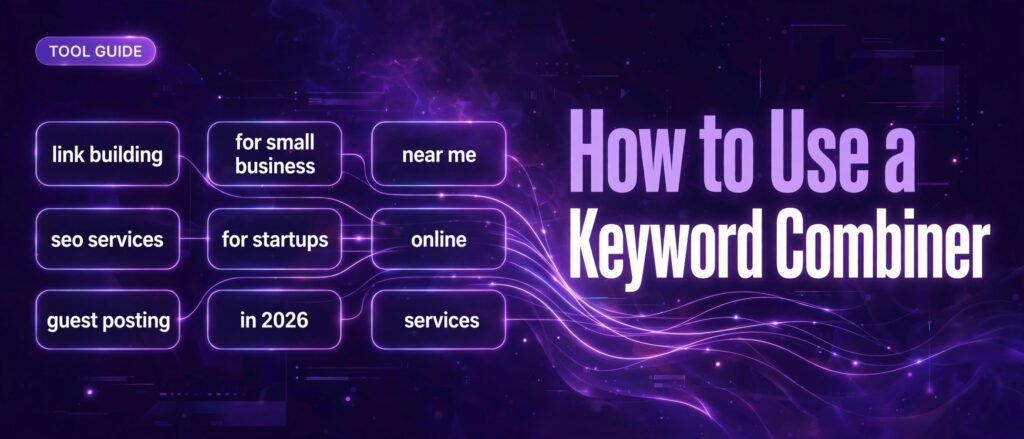
Learning how to use a keyword combination generator takes about five minutes, and the skill pays for itself every time you plan keywords. You type a few short lists of words, the tool joins them into every possible combination, and you walk away with a long list of keyword ideas that would take hours to type by hand. This guide shows you exactly how to use the free LinkTrixx Keyword Combination Generator, step by step, with the real example lists from the live tool, so you can follow along and see the same results on your own screen.
If you want the background first, our guide What Is a Keyword Combination Generator explains the idea in full: what a combiner is, why combinations matter for SEO and for ads, and how the maths works. This article is the practical companion to that guide. It covers the tool itself, the seven steps from an empty page to a cleaned keyword list, a second worked example built from the services a link building agency actually sells, how to build good word lists, how to clean the output, and how to turn the cleaned list into a content plan and into Google Ads ad groups. For the practical walkthrough of the matching position check, read How to Use a Keyword Position Checker.
What a keyword combination generator does, in brief
A keyword combination generator takes two or three short lists of words and joins them into every possible combination. You put core terms in the first column, modifiers in the second column, and optional qualifiers in the third column. The tool joins one item from each column, in order, to produce every combination. With 3 words in each of two columns you get 9 combinations, because 3 times 3 is 9. With 3 words in each of three columns you get 27, because 3 times 3 times 3 is 27.
That multiplication is the whole point of the tool. You never type the 27 phrases. You type 9 short entries, 3 in each column, and the tool does the joining. The output is raw, and it carries no search volume, no difficulty score, and no intent label. It is a list of candidates, and your job is to judge them, prune them, and check demand before you build anything around them. The combiner does the multiplying. You do the judging.
The free tool on this site runs entirely in your browser. Nothing you type is sent to a server, which matters when your lists encode unreleased products, client campaigns, or competitive strategy. There is no signup, no account, and no cost, and the combinations appear as you type, with no button to press.
Before you open the tool: three things to decide
A combiner multiplies whatever you give it, so five minutes of thinking before you type saves an hour of pruning afterwards. Decide three things first.
First, decide the goal. Are you building a content plan, an ads list, or a local SEO map? A content plan needs phrases that could each become a page or a section. An ads list needs phrases grouped by theme, with negatives in mind. A local map needs services in one column and places in another. The goal decides what goes in each column, and a list built for one goal rarely fits another without rework.
Second, decide the core terms. These are the services, products, or topics at the centre of the work, written in the words your customers use. For a link building agency the core terms might be link building, seo services, and guest posting. For a SaaS company they might be the product category and the two closest alternatives. Keep the list short, keep every entry at the same level, and do not mix a broad service with a narrow feature in the same column, or the combinations will mix levels too.
Third, decide the modifiers. Modifiers say who the searcher is, where they are, or when they are searching. For small business and for startups say who. Near me says where. In 2026 says when. Pick one kind of modifier per column, not three kinds mixed together, because a mixed column produces mixed phrases and half of them will be nonsense.
The tool at a glance
The free Keyword Combination Generator lives on this site, with the same header and footer as the rest of the site. It is free, with no signup, and everything runs in your browser.
The tool has three columns: Column 1, Column 2, and Column 3, which is optional. You type one word or phrase per line in each column. The instruction under the columns says, in full: One word or phrase per line in each column. Combinations update live as you type. There is no Generate button to press. The combinations appear as you type, and the count updates with them.
The placeholders show the intended shape of each list. Column 1 suggests link building, seo services, and guest posting. Column 2 suggests for small business, for startups, and in 2026. Column 3 suggests near me, online, and services. Those placeholders are examples, not a fixed sample. You replace them with your own words, and the tool works with whatever you type.
Three buttons sit below the columns, on the left: Load sample, Copy, and Download. Load sample fills the tool with a sample so you can see it work before you type your own lists. Copy copies the combination list to your clipboard. Download saves the list as a file. Copy shows the message Copied to clipboard. Download shows a confirmation message and saves a file called keyword-combinations.txt.
Before you type anything, the tool shows two empty states that explain what it needs. One reads: Add words to Column 1 and Column 2 to see keyword combinations here. The other reads: Add at least one word to Column 1 and Column 2 to generate combinations. Column 3 is optional throughout. The tool works with two columns, and the third column only multiplies what the first two already produce.
The note under the results states the privacy promise in plain words: the tool is free with no signup, your combinations are generated in your browser, and they are never uploaded. That promise is the reason the tool can be used for client campaign lists and unreleased product names without worry.
How to use a keyword combination generator, step by step
Follow these seven steps exactly, using the placeholder lists from the live tool, and you will see the same numbers the live tool shows: 9 combinations from two columns, then 27 from three. Keep the tool open beside this guide and type along.
Step 1: open the tool
Open the Keyword Combination Generator. You will see three empty columns, the instruction line, and the three buttons below them. No account, no email address, and no settings stand between you and the tool. If the columns already hold words from an earlier visit, clear them first, so you start from the empty states and see the messages the tool shows before anything is typed.
Step 2: fill Column 1 with core terms
Type one core term per line in Column 1. Use the placeholder shape as your guide: link building on the first line, seo services on the second, guest posting on the third. Core terms are the services or topics you actually offer. Keep them short, keep them in the words your customers use, and do not mix two different services into one line. At this point nothing appears in the results yet, because the tool needs Column 2 as well, and the empty state message tells you so.
Step 3: fill Column 2 with modifiers
Type one modifier per line in Column 2: for small business on the first line, for startups on the second, in 2026 on the third. Modifiers say who the searcher is, or when they are searching. As soon as Column 2 has its first entry, combinations appear, and the count reads 9 keyword combinations generated once all three lines are in place in both columns. Watch the count change as you type each line. That live update is the tool telling you the maths as it happens, and it is the fastest way to learn how quickly a list grows.
Step 4: read the 9 combinations
The 9 combinations, in the order the tool shows them, are: link building for small business, link building for startups, link building in 2026, seo services for small business, seo services for startups, seo services in 2026, guest posting for small business, guest posting for startups, and guest posting in 2026. The first 6 are listed in that order on the live tool, and the pattern continues through guest posting in the same way. Read them slowly. Three of them may be strong page ideas. Two may be weak. One may be nonsense. That judgement is your job, and it is the most valuable step in the whole workflow. Do not skip it, and do not copy the list before you have read it.
Step 5: add Column 3 and watch the count jump
Type near me on the first line of Column 3, online on the second, and services on the third. The count jumps to 27 keyword combinations generated. The first 3 are link building for small business near me, link building for small business online, and link building for small business services. Every combination from step 4 now appears three times, once with each Column 3 word on the end. That is the multiplication in action, and it is also the warning: a third column triples the pruning work as well as the output. If the two column output already covers your need, leave the third column empty.
Step 6: copy or download the list
Press Copy to put the full list on your clipboard, ready to paste into a spreadsheet or into Keyword Planner. Copy shows the message Copied to clipboard. Press Download to save the list as a file called keyword-combinations.txt. Work from the downloaded file from here on, so the browser tab can be closed without losing the list. If you plan to do the pruning in a spreadsheet, paste the list into one column and add columns beside it for volume, intent, and the page each phrase maps to. That sheet becomes your content plan and your ads plan in one place.
Step 7: prune before you use anything
Delete every combination that no real searcher would type, every duplicate, and every phrase that points at the wrong intent. In the example above, link building for small business services is awkward, and guest posting in 2026 is thin as a page idea on its own. Keep the survivors, and check them for demand before you build anything around them. The pruning step is covered in full later in this guide, because it is where most of the value lives.
The worked example in full: all 9, then all 27
It helps to see the whole output at once, so here is the complete worked example from the live tool, with a short judgement on each group of phrases. The lists are the placeholder lists from the tool itself: Column 1 holds link building, seo services, and guest posting. Column 2 holds for small business, for startups, and in 2026. Column 3 holds near me, online, and services.
With two columns filled, the tool shows 9 keyword combinations generated, in this order. Link building for small business is a strong commercial phrase, and it maps to a service page for small business owners. Link building for startups is also strong, and it maps to a page or a section aimed at founders. Link building in 2026 is a current year phrase, useful as a guide angle rather than a service page. Seo services for small business is strong, and it maps to a service page. Seo services for startups is strong, and it maps to a page aimed at young companies. Seo services in 2026 is a guide angle, useful inside a trends article. Guest posting for small business is usable, and it maps to a service page or a section. Guest posting for startups is usable, though weaker than the link building versions, because startups rarely search for guest posting first. Guest posting in 2026 is thin, and it works better as a section inside a guide than as a page of its own.
With three columns filled, the count becomes 27, and every two column phrase appears three times with a Column 3 word on the end. Link building for small business near me is a local phrase, and it suits a location page only if the business serves a local market. Link building for small business online is usable, and it maps to a service page for remote delivery. Link building for small business services is awkward, because services repeats the idea already in the phrase, and it should be cut. Seo services for startups near me is a local phrase, and it is worth keeping only if the agency takes local clients. Seo services for startups online is strong, and it maps to a service page. Seo services for startups services is awkward for the same reason as the link building version, and it should be cut. Guest posting for small business near me, guest posting for small business online, and guest posting for small business services follow the same pattern: the near me version is local, the online version is usable, and the services version is awkward and should be cut.
The pattern is the same in every example. About a third of the output is strong, about a third is usable with editing, and about a third should be deleted. That ratio is normal, and it is not a defect in the tool. A combiner cannot know which phrases carry demand, so it gives you everything and trusts you to judge. The judgement is fast once you practise it: read each phrase aloud, ask who would type it, and ask what page would satisfy them. If you cannot answer both questions, delete the phrase.
A second worked example: a link building agency list
The example above uses the tool placeholder lists. Here is a second example built from the services a link building agency actually sells, so you can see how the columns change when the business changes. This example is built by the author from the services LinkTrixx actually offers, and the 27 count is arithmetic, 3 times 3 times 3. The judgements about which combinations are strong or weak are editorial judgement about the phrases themselves, not claims about search volume or results.
Column 1 holds the services: link building, guest posting, and white label link building. Column 2 holds the audiences: for SaaS, for startups, and for agencies. Column 3 holds the qualifiers: pricing, services, and in 2026. Three lists of 3 give 27 combinations, from link building for SaaS pricing through to white label link building for agencies in 2026.
Read the 27 with a buyer eye. Link building for SaaS pricing is a strong commercial phrase, and it maps to a pricing page. White label link building for agencies is a strong service phrase, and it maps to the white label service page. Guest posting for startups in 2026 is weaker, because the year adds little to a service search, and it may work better as a section inside a guide than as a page of its own. Link building for agencies services is awkward and should be cut. The same test applies to every phrase in the list: who would type it, and what page would satisfy them.
This second example also shows why the audience column matters so much for a link building agency. The same service means something different to each audience. A SaaS company wants links to product and comparison pages. A startup wants fast, affordable placements. An agency wants white label delivery it can resell. The combinations make those differences visible, and the pages that follow should honour them. Our SaaS link building service and our white label link building service are built around exactly that split, and the keyword lists for each one should be built separately, not mixed into a single column.
For a larger organisation, the same lists feed a bigger plan. Our guide Enterprise Link Building Pricing shows what large scale link building costs and what drives the price, and Enterprise Link Building Metrics shows which numbers actually matter once a campaign is running. The combinations you build today are the raw material for those pages: pricing phrases map to pricing pages, metrics phrases map to reporting pages, and service phrases map to service pages.
Building good word lists: what goes in each column
Good output starts with good lists. The combiner multiplies what you give it, so a careless list gives you a long list of careless phrases. Three rules govern all three columns, and five habits keep the lists clean.
Column 1: core terms, the thing you sell or write about
Column 1 holds the core terms: the services, products, or topics at the centre of the work. Use the words your customers use, not the words your industry uses internally. Link building is a core term. Guest posting is a core term. Seo services is a core term. Keep each entry to one phrase, keep the list short, and keep every entry at the same level: do not mix a broad service with a narrow feature in the same column, or the combinations will mix levels too. If you sell three services, put the three services in Column 1. If you write about one topic, put the topic and its two closest synonyms in Column 1.
Column 2: modifiers, the who, where, and when
Column 2 holds the modifiers: who the searcher is, where they are, or when they are searching. For small business and for startups say who. Near me says where. In 2026 says when. For SaaS and for agencies say who, in a business to business sense. A good modifier column has one kind of modifier in it, not three kinds mixed together, because a mixed column produces mixed phrases and half of them will be nonsense. If you need audiences and locations, run the tool twice: once with audiences in Column 2, once with locations. Two clean runs beat one muddled run.
Column 3: qualifiers, the intent word
Column 3 holds the qualifiers: the word that says what the searcher wants to do. Pricing, cost, services, guide, and checklist are qualifiers. Online and near me can work as qualifiers too, though they also work as modifiers, and the choice of column matters less than the consistency of the list. Keep qualifiers short, keep them at the same level, and remember that Column 3 is optional: if the two column output already covers your need, leave the third column empty. A third column should earn its place by adding intent you actually need, not by adding words for the sake of it.
Five list building habits that save hours
First, one phrase per line, always. A line with two phrases in it produces combinations that contain both, and the output doubles in confusion. Second, no duplicates across a column, because a duplicated entry produces duplicated combinations. Third, consistent form: if one entry is plural and the next is singular, the output will mix them, so pick one form per column. Fourth, short lists first: start with 3 entries per column, read the 27, then grow the lists only where the output stays clean. Fifth, write the lists from real customer language: sales calls, support tickets, and Search Console queries beat brainstorming from memory every time. If your customers say link building services and your team says link acquisition, put link building services in the list, because the list should sound like the searcher, not like the seller.
Copy, download, and save your list properly
The Copy and Download buttons look simple, and they are, but the habit around them decides whether the list survives the session. Press Copy to put the full list on your clipboard, ready to paste into a spreadsheet or into Keyword Planner. Copy shows the message Copied to clipboard. Press Download to save the list as a file called keyword-combinations.txt. Work from the downloaded file from here on, so the browser tab can be closed without losing the list.
Paste the list into a spreadsheet with four columns beside it: the phrase, the volume range, the intent, and the page it maps to. That sheet is your content plan and your ads plan in one place, and it is the document the combiner output was always meant to become. Keep one sheet per topic, not one sheet for the whole site, because a topic sheet stays readable while a site wide sheet becomes a dump.
Save the raw download as well as the cleaned sheet, and name the file by topic and date, so you can re run the same lists later and compare the output. The raw file is the record of what the tool produced. The cleaned sheet is the record of what you decided. Both matter, because a phrase you delete today may become a page idea next quarter, and the raw file is where you will find it again.
One more habit: do the pruning in the spreadsheet, not in the tool. The tool shows the live list, and it is the wrong place to edit. The spreadsheet lets you sort, filter, delete in bulk, add notes, and share the list with a colleague. Copy once, then close the tab and do the thinking where thinking is easy.
How to clean the output: six checks in order
Cleaning is a repeatable pass, not a feeling. Run every combination list through these six checks, in order, and keep only the phrases that pass all six. The order matters, because each check removes a different kind of waste, and the later checks are only worth doing on phrases that survived the earlier ones.
First, sense: would a real person type this phrase into Google? Delete anything you cannot imagine a person typing. Link building for small business services fails this check, because no one types services twice in one phrase. Second, intent: does the phrase point at the page you want to build, or at a different job entirely? Delete the mismatches, and move the job seeking and freebie phrases to the negative list for ads. Third, duplicates: remove exact duplicates and near duplicates that would split one page into two. Fourth, demand: check the survivors in Keyword Planner and drop the phrases with no visible demand, unless the intent is clearly commercial. Fifth, difficulty: search the survivors in Google and read the top ten pages. A results page full of major publications is a harder target than a page full of thin posts, and that reading costs nothing. Sixth, mapping: give each survivor a page, a section, or an ad group. A phrase with no home is not a keyword, it is a note, and notes belong in a backlog, not in a campaign.
Be ruthless in the first two checks and patient in the last four. The first two checks are judgement, and they are fast. The last four checks are evidence, and they take time, so spend that time only on phrases that earned it. A list of 27 that becomes 9 strong phrases is a success, not a failure. Nine phrases with demand, a page, and a plan beat 27 phrases with none of those.
Check demand before you build anything
A combiner makes candidates, not data. It joins your lists and shows every combination, but it does not know which phrases people actually search for, because it holds no search data. The demand check is the step that turns candidates into keywords, and it comes from a tool that holds search data.
Paste the survivors into Google Keyword Planner, which sits inside a Google Ads account and is free to use. Planner returns keyword ideas with search volume, trends, competition level, and bid ranges. For accounts without active ad campaigns, Google often shows volume in ranges, such as 100 to 1,000 searches per month, instead of exact numbers. That is enough to sort the survivors into real demand, thin demand, and no demand. Drop the no demand phrases, and keep the thin demand phrases only where the intent is clearly commercial, because a commercial phrase with thin volume can still be worth a page.
Our comparison guide Free Keyword Combination Generator vs Paid SEO Tools explains the paid side of the same check: Ahrefs, Semrush, Moz, KWFinder, and keywordtool.io all add difficulty scores, click data, and competitor gaps that Planner does not offer. Use the free check first, and pay for the difficulty check only when the shortlist justifies it. For most small sites, the free check plus a read of the top ten results in Google is enough to decide.
Two cautions belong here. First, volume is not value. A phrase with 10 searches a month from buyers beats a phrase with 1,000 searches a month from browsers, and the combiner output is full of both. Second, zero volume in Planner does not always mean zero searches. Planner rounds small numbers and hides some phrases entirely, so a phrase with a clear buyer behind it deserves a page even if Planner shows nothing, provided the intent is strong and the page is cheap to write. Judge demand with volume and intent together, never with volume alone.
Turning combinations into a content plan
A combination list becomes a content plan in four moves: filter, check, group, and map. Skip any one of them and the list stays a list.
Filter for sense and intent first, using the six checks above. In the agency example, link building for agencies services goes, guest posting for startups in 2026 is demoted to a section idea, and link building for SaaS pricing stays. Judge each survivor by two questions: who would type this, and what page would satisfy them. If you cannot answer both, delete the phrase.
Check demand in Keyword Planner, as above, and sort the survivors into real demand, thin demand, and no demand. Group the survivors into clusters by topic, not by column. All the link building for SaaS phrases belong together, whether they came from Column 2 or Column 3. All the guest posting phrases belong together. Each cluster is a topic, and each topic gets one strong page plus supporting sections. A cluster of long tail phrases with individual volumes as low as 30 can add up to a collective volume near 1,000, as Semrush reports in its long tail guide, which is why clusters beat single keywords as a planning unit. Our guide What Are Long Tail Keywords explains why that specificity wins, and the worked example How to Use a Long Tail Keyword Generator shows how a seed becomes a cluster.
Map each cluster to a page that matches its intent. A pricing cluster maps to a pricing page. A guide cluster maps to a guide. A services cluster maps to a service page. Never map two clusters to the same page, and never map one cluster to two pages, because both mistakes split the ranking signal. Google Search Central advice on creating helpful content makes the same point: useful content should satisfy the searcher need and purpose. The page that wins is the page that answers the whole cluster better than any other page answers any part of it.
For link building agencies, the mapping is direct. Pricing phrases map to pricing pages, service phrases map to the link building services page, white label phrases map to the white label link building page, SaaS phrases map to the SaaS link building page, and guest posting phrases map to the guest posting page. A phrase that maps to no service page is either a guide idea or a phrase to delete, and the answer is usually obvious once the question is asked.
Turning combinations into Google Ads ad groups
For ads, the same four moves apply, with match types and negatives added. Build one ad group per cluster, not one ad group per combination, because an ad group with 27 near identical keywords and one landing page is harder to manage than an ad group with 9 strong keywords and a message that matches them all.
Set match types deliberately. Exact match gives the most control and the smallest reach, and it suits the proven converters you already know. Phrase match is the practical middle ground for new keywords that are not brand terms. Broad match reaches the widest set of related searches, and it works best paired with Smart Bidding and clean conversion data, because the bidding algorithm can price each auction individually. Google Ads Help states that broader match types capture all the searches of the narrower ones, plus more, so you do not need to repeat keywords across match types to cover the same ground. Read the official page, About keyword matching options, before you build an ads list from any generator output, because the behaviour of each match type decides how much of your budget a combination list can spend.
Add negatives from the same list. The combiner output always contains phrases you do not want to bid on: free and cheap variants for a premium service, job seeking phrases, and location phrases outside your service area. Put those on the negative list at the ad group or campaign level before the campaign goes live, not after the budget has been spent on them. The negative list is the most valuable part of a combiner run for ads, because the tool finds the phrases to exclude at the same time as it finds the phrases to target.
Keep the landing page matched to the ad group. A combination list that promises link building for SaaS pricing should land on a page that shows SaaS pricing, not on a general homepage. The match between the keyword, the ad, and the landing page is what turns clicks into enquiries, and a combiner list that is well grouped makes that match easy to keep. If you cannot find a landing page that matches a cluster, the cluster is not ready to bid on, and the page should be built first.
Using combinations for local SEO
Combinations are the quickest way to map location pages and blog topics for local SEO. Put services in Column 1, towns, cities, or neighbourhoods in Column 2, and modifiers such as near me or services in Column 3. The output is a full map of the location pages you could build, and it shows the gaps in your coverage at a glance.
The caution is as important as the technique. A location page only deserves to exist if it says something real about that location: a local case, a local team member, a local service difference, or local proof. A page that swaps only the town name and repeats the same paragraph is a thin page, and a site full of thin pages is worse than a site with fewer, stronger pages. Use the combiner to find the locations, then write each page as if it were the only page on the site.
The same caution applies to programmatic SEO, where many pages are built from one template and a list of data, such as a page for each city and each kind of workspace. A combiner can generate the page titles and the keyword lists for that programme in minutes. It cannot supply the local detail that makes each page worth ranking. Generate the list with the tool, then earn each page with real content.
Seven mistakes to avoid with a keyword combination generator
The first mistake is building a huge list nobody filters. Three lists of 20 items give 8,000 combinations, and nobody reads 8,000 phrases. Start with 3 items per column, read the 27, and grow the lists only where the output stays clean. A short list you actually read beats a long list you never open.
The second mistake is keeping the nonsense pairs. A combiner pairs everything, including phrases no searcher would type, and those phrases pollute every later step if they survive: they waste Planner checks, they bloat ad groups, and they become thin pages. Prune ruthlessly. Deleting is the work, not generating.
The third mistake is treating the output as a keyword list ready to publish. The output is candidates, not data. It carries no volume, no difficulty, and no intent label. Every phrase needs a demand check before it earns a page or a bid.
The fourth mistake is duplicating entries across a column, or mixing levels inside a column. A duplicated entry doubles its combinations. A column that mixes audiences with locations produces phrases that mix both, and half of them will be nonsense. One kind of word per column, one form per column, no duplicates.
The fifth mistake is building thin location or programmatic pages from the list. A combiner can generate a thousand page ideas in a minute. A thousand thin pages is a liability, not an asset. Build the pages that deserve to exist, with real local detail, and leave the rest as ideas.
The sixth mistake is forgetting the searcher. A combination is a phrase, not a person. Read each survivor aloud, ask who would type it, and ask what page would satisfy them. If the answer is vague, the phrase is vague, and vague phrases make vague pages.
The seventh mistake is using the tool once and never returning. Keyword lists go stale as services change, audiences shift, and years roll over. The in 2026 modifier in the example will be wrong in 2027, and the pricing phrases will be wrong when the pricing changes. Re run your core lists once a quarter, compare the output with the old file, and update the pages that the new list points to. The tool is free, the run takes minutes, and the habit keeps the content plan honest.
How the combiner fits with the other free tools
Keyword combinations sit at the start of a publishing checklist, and the other free tools on this site cover the steps that follow. The SERP Preview guide and the walkthrough How to Use a SERP Preview Tool check the title and description before you publish. Our comparison Free Long Tail Keyword Generator vs Paid SEO Tools sets out when paid keyword data is worth buying, and the new comparison Free Keyword Combination Generator vs Paid SEO Tools does the same for combiners. Research the phrase, write the page, check the preview, then publish.
Use the tools in order: generate ideas from a seed with the long tail generator, multiply your own lists into combinations with the combiner, then check demand in Keyword Planner. A paid tool adds difficulty and competitor data after that. The combiner is the middle step, and it is the step most people skip, which is why most keyword lists are either too short, because they were typed by hand, or too long, because they were never pruned.
The short answer to the question in the title is this. Open the free LinkTrixx Keyword Combination Generator, type one phrase per line in each column, watch the combinations update live as you type, copy or download the list, prune it with the six checks, check demand in Keyword Planner, and build pages and ad groups only for the phrases that survive. The tool does the multiplying. You do the judging.
Frequently Asked Questions
How do I use a keyword combination generator?
Open the free Keyword Combination Generator and type one word or phrase per line in each column. Column 1 holds core terms such as link building, seo services, and guest posting. Column 2 holds modifiers such as for small business, for startups, and in 2026. Column 3 is optional and holds qualifiers such as near me, online, and services. Combinations update live as you type, with no Generate button to press. When all three lines are in place in the first two columns, the tool shows 9 keyword combinations generated. Press Copy to copy the list, or Download to save it as a file called keyword-combinations.txt.
How many combinations will I get from my word lists?
Multiply the number of entries in each column. Three entries in Column 1 and three in Column 2 give 9 combinations, because 3 times 3 is 9. Add three entries in Column 3 and the count becomes 27, because 3 times 3 times 3 is 27. Ten entries in each of three columns give 1,000 combinations, and twenty in each give 8,000. Start with 3 entries per column, read the 27, and grow the lists only where the output stays clean, because a few extra words in each column can produce a list far longer than you expected.
Does the LinkTrixx Keyword Combination Generator show search volume?
No. A combiner makes candidates, not data. It joins your lists and shows every combination, but it does not know which phrases people actually search for, because it holds no search data. Check the cleaned list in Google Keyword Planner for volume ranges, and check difficulty by reading the top ten pages in Google, or in a paid tool. Our comparison Free Keyword Combination Generator vs Paid SEO Tools explains what paid tools add, and when free is enough.
What should I put in each column?
Column 1 holds core terms, the services, products, or topics at the centre of the work, written in the words your customers use. Column 2 holds modifiers, who the searcher is, where they are, or when they are searching. Column 3 is optional and holds qualifiers, the word that says what the searcher wants to do, such as pricing, guide, or services. Keep one kind of word per column, keep the form consistent, use one phrase per line, and never mix two different services into one line.
Can I use keyword combinations for Google Ads?
Yes, and ads work is one of the best uses for a combiner. Build one ad group per cluster, not one ad group per combination, set match types deliberately, and add negatives from the same output. Broad match is the default and reaches the widest set of related searches. Phrase match shows your ad on searches that include the meaning of your keyword. Exact match gives the most control and the smallest reach. Google Ads Help explains that broader match types capture all the searches of the narrower ones, plus more, so you do not need to repeat keywords across match types. Keep the landing page matched to the ad group, and put free, cheap, and job seeking variants on the negative list.
Is the LinkTrixx Keyword Combination Generator free?
Yes. The tool is free with no signup, and everything runs in your browser, so nothing you type is uploaded. It has three columns, with the third optional, combinations that update live as you type, a count of how many combinations were generated, and Copy and Download buttons. Before you type anything it shows the message Add words to Column 1 and Column 2 to see keyword combinations here, and the tool works with two columns alone, adding the third only when you want the list multiplied further.