
Link Building Pricing Per Link: 2026 Rate Guide by DR Tier
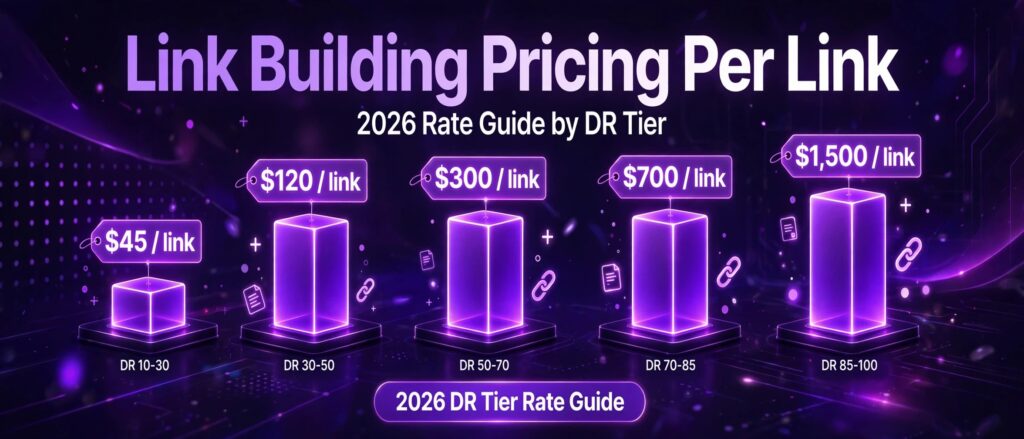
Link Building Pricing Per Link: 2026 Rate Guide by DR Tier
Link building pricing per link in 2026 runs from about $50 for a budget link insertion on a low authority site to $2,000 or more for a guest post on a DR 70 plus publication. The most quoted single benchmark comes from Editorial.Link’s survey of 518 SEO professionals: the average price they consider acceptable for one high quality backlink is $508.95. ReporterOutreach’s 2026 survey adds the market mood: 76 percent of SEO professionals will pay $300 or more per link, with the largest band, 31 percent, sitting at $500 to $1,000.
If you have ever received three quotes for what sounded like the same link and they ranged from $80 to $900, this guide explains why. Below is the per link rate card for 2026 built from real marketplace and survey data: guest post rates by DR tier, insertion rates by DR tier, the head to head comparison, what moves a single link’s price up or down, and how to compare two quotes without overpaying or buying junk.
For the campaign level picture, retainers, monthly budgets and total spend, see our breakdown of how much link building costs overall. For the basics of what these services actually do, start with what link building services are. And when you want an exact number for your market, our link building services quotes are built around the competitor gap in your niche, not a flat rate card.
What DR Measures (and What It Does Not)
DR, or Domain Rating, is Ahrefs’ 1 to 100 score for the strength of a website’s backlink profile. Domain Authority is Moz’s separate 1 to 100 prediction of ranking ability. They are two different scores from two different companies, so a “DA 30” price and a “DR 30” price are not the same product. This guide uses DR throughout because most 2026 pricing datasets are published in DR bands.
DR is a useful sorting filter, but it does not measure:
- Organic traffic. A DR 55 site can have near zero traffic if its links are artificial.
- Topical relevance. DR says nothing about whether the site’s audience matches yours.
- Editorial standards. DR cannot tell a real publication from a well built link farm.
Rule of thumb for the rest of this guide: DR sets the price band, traffic and relevance decide what a link is actually worth. Never buy on DR alone.
Guest Post Pricing Per Link by DR Tier in 2026
Guest posts are the most commonly priced link building product. Five independent 2026 datasets, from vendor medians to live marketplace averages to published provider rate cards, tell a consistent story: prices climb with the score, and the steepest step is at the very top of the scale.
The master rate table: one guest post link
| DR tier | Typical per link range | Buyer notes |
|---|---|---|
| DR 20 to 35 (Budget) | $50 to $150 | Niche blogs, early authority building, tier two support links |
| DR 35 to 55 (Mid range) | $120 to $400 | Core workhorse tier for most commercial campaigns |
| DR 55 to 70 (Premium) | $300 to $800 | Established publications, pickier editors, competitive keywords |
| DR 70 plus (Enterprise) | $600 to $2,000 plus | Major industry publications and national media, negotiated case by case |
What the datasets say behind those ranges
Vendor medians (ESBO, compiled by RhinoRank from live marketplace pricing): $355 at DR 30 to 39, $465 at DR 40 to 49, $510 at DR 50 to 59, $830 at DR 60 to 69, $1,230 at DR 70 to 79, and $1,840 at DR 80 and above. That is a 5.2x spread from bottom to top.
Marketplace averages (Adsy, 52,671 site inventory, February 2026 data): $332 per link at DR 1 to 30, $555 at DR 31 to 70, and $2,025 at DR 71 and above.
Live buyer prices (Serpzilla, 2026 marketplace data): DR 0 to 20 at $80 to $130, DR 20 to 40 at $130 to $220, DR 40 to 60 at $220 to $400, DR 60 to 80 at $400 to $700, and DR 80 to 100 at $700 to $1,200 plus. Serpzilla notes these are what buyers actually pay, not theoretical models.
Agency retail pricing (OutreachDesk, updated October 2026): DR 20 to 30 at $150 to $300, DR 30 to 50 at $300 to $600, and DR 50 plus industry publications at $600 to $1,500 plus. The price gap, in their words, comes down to editorial standards: some publishers want expert written 2,000 word articles with custom graphics, others move fast with a clear 800 word pitch.
Provider rate cards (Cutting Edge PR, comparison of ten providers’ public cards): budget guest posts at $50 to $120 (DR 20 to 35), mid range at $120 to $300 (DR 35 to 55), premium at $300 to $600 (DR 55 to 70), and enterprise at $600 to $2,000 plus (DR 70 and above). Finance, health and legal command a premium for high editorial standards and advertiser competition.
Service tiers (BacklinkGrid): budget DR 15 to 30 at $50 to $150, standard DR 25 to 45 at $100 to $250, quality DR 40 to 60 at $200 to $500, and premium DR 60 plus at $500 to $2,000 plus.
The pattern is unmistakable. Budget placements cluster under $150, the commercial core sits between $200 and $600, and anything above DR 70 starts at $600 and climbs fast. When a quote lands far outside these bands for its tier, something in the quote deserves a second look.
Link Insertion Pricing Per Link by DR Tier in 2026
Link insertions, also called niche edits, place your link inside an existing article that already ranks and is already indexed. No new content is written, which is why they usually cost less than guest posts at the same tier. The 2026 datasets:
| DR tier | Typical per link range | Notes |
|---|---|---|
| DR 20 to 40 | $50 to $175 | Good for tier two support or niche content clusters |
| DR 40 to 60 | $141 to $350 | Core workhorse tier for most commercial campaigns |
| DR 60 to 75 | $250 to $500 | Premium insertions on established editorial sites |
| DR 75 plus | $365 to $800 plus | High authority aged content, rare but high impact |
What the datasets say
OutreachZ 2026 market data: DR 20 to 40 at $50 to $140, DR 40 to 60 at $141 to $250, DR 60 to 75 at $250 to $365, and DR 75 plus at $365 to $600 plus.
BacklinkGrid service tiers: budget DR 15 to 30 at $30 to $100, standard DR 25 to 45 at $75 to $175, quality DR 40 to 60 at $150 to $350, and premium DR 60 plus at $300 to $800.
Editorial.Link practitioner bands: lower end insertions at $50 to $85, mid range at $100 to $150, and high end placements with prime positioning at $300 to $365.
Benchmark averages: BuzzStream puts the average link insertion at around $141. Ahrefs’ own outreach experiment across 450 sites found paid niche edits averaged $361.44. SalesHive’s July 2026 pricing study puts the typical insertion at around $141, rising to about $600 on DR 50 plus sites.
One honest nuance: the “insertions are cheaper” rule holds across the middle of the market, but it can flip at the top. A link inserted into a three year old article that ranks for competitive terms and carries its own backlinks can cost more than a fresh guest post on a similar DR domain, because you are buying the page’s existing authority, not just the domain’s. Always ask for the target URL before approving an insertion, and check that the page genuinely receives traffic.
Guest Posts vs Link Insertions: Per Link Compared
| DR tier | Guest post | Link insertion | Insertion discount |
|---|---|---|---|
| DR 20 to 40 | $100 to $300 | $50 to $175 | Roughly 30 to 50 percent |
| DR 40 to 60 | $200 to $500 | $141 to $350 | Roughly 20 to 40 percent |
| DR 60 to 75 | $500 to $1,000 | $250 to $500 | Roughly 30 to 50 percent |
| DR 75 plus | $600 to $2,000 plus | $365 to $800 plus | Varies, narrows at the top |
Practitioner sources converge on the same finding. ReporterOutreach’s 2026 niche edit guide puts mid DR insertions at $200 to $600 against guest posts at $300 to $800, calling insertions roughly 20 to 30 percent cheaper because the host page brings existing authority. OutreachZ lands at 20 to 30 percent cheaper after accounting for writing costs. BacklinkGrid puts the gap at 30 to 50 percent, driven by no content creation, faster turnaround and a simpler process. ReportCard’s 2026 comparison notes the same 20 to 30 percent gap at comparable DR and traffic.
The discount is not free money. Insertions trade away what guest posts buy: editorial control over the surrounding content, a new asset you can point to, bylined brand exposure, and links that keep earning citations for years. Editorial.Link’s bottom line is blunt: insertions get the job done faster and without the extra costs of copywriting, proofreading or months of pitching. SetProduct’s framing is the practical one: pick a guest post when you want control and a durable asset, pick an insertion when you need a relevant link inside a page that already ranks and you want it live this month on a smaller budget. Most serious campaigns run both, and the deadline and budget decide, not the label.
What Moves a Single Link’s Price Up or Down
Two links at the same DR can cost five times apart. These are the levers behind the spread:
Organic traffic. This is the biggest honest price mover. BuzzStream found a vendor charges $229 for a site with under 100 organic visits a month and upwards of $3,210 for a site over 100K. ESBO’s medians tell the same story: $390 for sites with 2,000 to 5,000 monthly visits against $2,030 for the 425 sites with over a million. A DR 50 site with zero traffic is worth less than a DR 30 site ranking for hundreds of keywords. Read traffic beside the score on every quote.
Niche difficulty. Finance, health, legal, SaaS, insurance, gambling and cannabis cost more because publishers are pickier and outreach is harder. SalesHive reports a 30 to 50 percent premium in high competition YMYL niches. Cutting Edge PR’s rate card comparison flags the same premium for finance, health and legal.
Relevance. A placement on a site your buyers actually read commands a premium over a generic multi niche blog, and it should. Relevance beats raw authority for both rankings and business.
Content quality. Real guest post pricing includes 1,000 plus words of native quality content. ReportCard’s 2026 comparison puts ghostwriting for a DR 60 plus site at $200 to $500 per piece. If a quote excludes writing, add that cost before comparing it to an all in quote.
Page level authority for insertions. An insertion’s value lives in the specific page, not the domain. An aged article with its own backlinks and steady traffic justifies a higher insertion price than a fresh post on a stronger domain. This is also where the insertion discount narrows or flips.
Where your money goes. One under discussed fact: of the $300 to $1,250 a bought guest post or listicle placement costs, the site owner often sees only $25 to $150, per practitioner discussion on r/bigseo. The rest is prospecting, outreach, negotiation, content and margin. That is not an argument against agencies. It is the reason a $60 “DR 50 guest post” cannot possibly include real outreach, real content and a real editor.
How to Compare Two Quotes for the Same Link
When two vendors quote the same DR tier at very different prices, run this checklist before choosing the cheaper one:
- Ask for the target URL. For insertions this is non negotiable. Check the page in Ahrefs or SEMrush: does it rank, does it get traffic, is it topically relevant.
- Check organic traffic, not just DR. A DR 45 site with 10,000 monthly visitors beats a DR 60 site with minimal real traffic. Cutting Edge PR’s own FAQ makes this exact point.
- Confirm what is included. Content written to what length and standard. Revisions. Dofollow placement. Permanent placement or time limited.
- Confirm the site is real. Real about page, real authors, real publishing cadence, traffic that matches the claims. BuzzStream’s finding explains why this matters: 85.3 percent of sites listed on open guest post marketplaces are low quality, DR below 40 with fewer than 10,000 monthly organic visitors.
- Check the anchor and surrounding content. For insertions, you get anchor control, which is an advantage, but keep distribution natural: heavy exact match anchors are a footprint.
- Read the placement terms. Some sellers place links in footers, sidebars or author bio boxes on high DR homepages and call it a placement. Editorial in content links are what you want.
6 Traps in Per Link Pricing
1. DR without traffic. A DR 50 site with 200 monthly visitors is worth less than a DR 30 site with 20,000. The 85.3 percent low quality figure above is the reason cheap bulk placements underperform: most open marketplace inventory does not pass the threshold Google needs to credit a link.
2. Flat rate regardless of site. A provider charging $150 per link whether the site is DR 25 or DR 65 is placing everything from the same low tier pool. Real inventory prices on a curve, and the curve is steep at the top.
3. Hidden content fees. Some quotes exclude writing. Quality guest post content for strong sites runs $200 to $500 per piece. If writing costs extra, add it before comparing.
4. PBN links priced as editorial. Private blog networks can show inflated DR. Signs: no real traffic, thin content, every post carrying outbound links to commercial pages. Check traffic and read three articles before approving any domain.
5. High DR homepage and footer links. Some sellers place your link sitewide in a footer or sidebar and sell it as a high DR placement. These are low value and can look manipulative. You want an editorial link inside real content.
6. The too cheap premium tier. Anything advertised as a “DA 50 plus” placement under $80 is a red flag, not a bargain. PC Tech Mag’s July 2026 review puts the stable wholesale range for consistent quality at $180 to $300 per link. Below that floor, something in the chain is fake: the metric, the traffic, or the editorial process.
A final word on safety: Google’s link spam policies are explicit that links intended to manipulate rankings can trigger penalties. The entire pricing logic above assumes real sites, real editors and real content. That is the only segment of this market worth buying from.
Frequently Asked Questions
What is a good price per link in 2026?
For a quality editorial link, $300 to $750 per placement covers the commercial core of the market, and $508.95 is the average price SEO professionals call acceptable for one high quality backlink (Editorial.Link, 518 respondents). Under $150 usually means budget tier inventory. Over $1,000 means premium publications or top tier DR.
Are link insertions cheaper than guest posts?
Usually, by 20 to 50 percent at comparable DR and traffic, because no content is written and the page already exists. The gap narrows on premium aged pages where the existing ranking is itself valuable. Compare per placement with content costs included before deciding.
Why do quotes for the same DR vary so much?
Because DR is only one input. Traffic, niche difficulty, relevance, content quality, page level authority and how thoroughly the vendor vets publishers all move the price. Two DR 50 quotes $200 apart are often two completely different products.
Should I buy the cheapest per link option?
Rarely. With 85.3 percent of open marketplace sites falling below the quality threshold, the cheapest options concentrate exactly where the junk lives. Buy the cheapest link that clears your quality bar: real traffic, real editors, topical fit, permanent dofollow placement.
Does DR or organic traffic matter more when judging a quote?
Traffic, read beside DR. DR tells you the domain’s link profile strength. Traffic tells you whether anyone actually reads the site. A quote that leans only on DR is hiding the more important number.
How many links per month should I buy at these prices?
Most SEO professionals recommend a consistent cadence of 4 to 8 quality placements per month depending on domain age and competition, with results typically appearing within 60 to 120 days (Cutting Edge PR, 2026). Consistency beats intensity: steady buying month after month outperforms a single burst.
Next step: stop pricing links in the abstract. Share your URL, keywords and competitors and we will run the gap analysis and send a custom quote built around the links you are actually missing, at the tiers your market requires.
Sources
Figures in this article are drawn from these published 2026 sources, checked 2026-10-13:
- RhinoRank, “Guest post pricing: what guest posts cost, by DA tier” (ESBO medians, Adsy averages, BuzzStream vendor prices, February to June 2026 data): https://www.rhinorank.io/blog/guest-post-pricing/
- Serpzilla, “Guest Post Pricing in 2026: How Much Should You Pay by DR and Niche” (2026 marketplace data by DR range): http://serpzilla.com/blog/how-much-should-you-pay-for-a-guest-post/
- OutreachDesk, “Link Building Pricing: What Backlinks Cost Per Link in 2026” (agency retail tiers, Ahrefs $361.44 niche edit figure): https://outreachdesk.com/link-building-pricing/
- Cutting Edge PR, “Best guest posting services in 2026 (ranked and reviewed)” (ten providers’ public rate cards by tier): https://cuttingedgepr.com/articles/best-guest-posting-services-in-2026-ranked-reviewed/
- OutreachZ, “Guest Posting vs Niche Edits: The Definitive Link Building Comparison” (2026 niche edit pricing tiers by DR): https://outreachz.com/blog/guest-posting-vs-niche-edits/
- BacklinkGrid, “Guest Posts vs Niche Edits: Full Comparison” (2026 service cost tiers, DIY time costs): https://backlinkgrid.com/comparisons/guest-posts-vs-niche-edits-full-comparison
- ReporterOutreach, “Niche Edits (Link Insertions): Complete Guide for 2026” (insertion vs guest post cost and speed comparison): https://www.reporteroutreach.com/blog/link-insertion-key-to-strong-and-effective-link-building-campaign
- Editorial.Link, “Guest Posting vs Niche Edits: Which Is Better in 2026” (practitioner price bands, Ahrefs and BuzzStream averages): https://editorial.link/guest-post-vs-niche-edits/
- ReportCard, “Guest Posts vs Niche Edits: Which Link Building Strategy Wins in 2026” (content costs, 85.3 percent low quality marketplace figure): https://reportcard.com/blog/guest-posts-vs-niche-edits/
- SetProduct, “Guest posts vs niche edits, which link type to buy in 2026” (cost, time to link and risk comparison): https://www.setproduct.com/blog/guest-posts-vs-niche-edits
- 3Way Social, “SaaS Link Building Cost in 2026: Per Link and Package Prices” (updated October 9, 2026; per link type breakdown): https://3way.social/blog/saas-link-building-cost/
- SalesHive, “Link Building Pricing: How Much Does It Cost in 2026” (updated July 1, 2026; insertion and guest post averages): https://saleshive.com/blog/link-building-pricing-how-much-does-link-building-cost
- Editorial.Link survey of 518 SEO professionals (average acceptable price $508.95), via SERPreach and 3Way Social: https://serpreach.com/how-much-does-a-seo-cost/ and https://3way.social/blog/saas-link-building-cost/
- ReporterOutreach, 2026 State of Link Building survey (willingness to pay bands), via practitioner corpus: https://github.com/superagnt/plugins/blob/HEAD/plugins/super-seo/skills/super-seo/references/link-building-white-hat.md
- Ahrefs, Domain Rating definition: https://ahrefs.com/blog/domain-rating/
- Moz, Domain Authority definition: https://moz.com/learn/seo/domain-authority
- Google Search Central, Spam policies (link spam): https://developers.google.com/search/docs/essentials/spam-policies